Friday, 17 September 2010

First "real" ILS on the Be76, CPL Test Profile and 737-200 sim session

We had a lot going on this last few days. That was a pretty busy week indeed, starting with two days of absolutely crap weather (windy, low clouds forming an overcast layer just above the 500 foot mark, and to make it even better, some rain showers pretty much everywhere in this part of the country).
Perfect weather to do the instrument flying bit of the CPL course. Although we were flying instruments in actual instrument meteorological conditions (IMC), we did use the screens as we popped out of the clouds eventually, enjoying (well, when backseating) some nice sunshine whilst people below us were enjoying some rain ...
On the way back of those two flights, we got the chance to do a Radar Vectored ILS, and break out from clouds around 700ft, with the runway magically appearing in sight right in front of us. The feeling resulting from this is really intense, it really is a huge joy after some really tough work keeping the plane on the glide path and centred on the localizer to pop out of the clouds and happen to be correctly aligned and at the correct height.

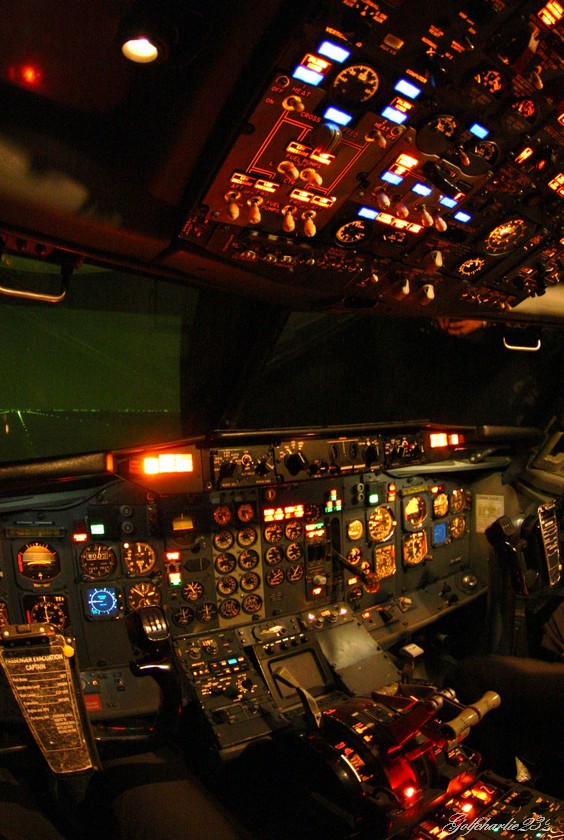
As Steve and I booked our MCC (Multi-Crew Co-Operation) course at European Skybus on the 737-200 Full Flight Simulator (full motion), we got the chance to get our hands on her for a circuit from London Stansted. We now can't wait to get started with that last part of the training (which should take place sometime between December and January).

Wednesday was the first Test Profile, a two hour flight to Blackbushe (just North of Farnborough, on the edge of London). The way out was made up from two planned legs (visual navigation) with a Matz penetration (Boscombe), joining the circuit pattern at Blackbushe, doing some flapless approach, engine failure after take-off, one engine go-around (N-1), then departing through the overhead to then fly through Farnoborough's ATZ on a diversion leg (unplanned navigation) towards the Coast, doing some radionav position fixes on the way. Then came the general handling part, where we had to show some stalls recovery, steep turns, engine fire drill and emergency descent. And finally, on the way back home, some instrument flying (with the screens), partial panel, unusual attitudes recovery, and VOR tracking (HSI/RMI). Just before joining the circuit pattern at Bournemouth, we had to deal with an engine failure (simulated) and land on one engine.

Thursday, a much more relaxing flight (in a way) practicing general handling, instrument flying and NDB tracking.
And on friday, another Test Profile, to Dunkeswell this time.
If we get along with the weather, both Steve and I should have our 170 test on monday and the CPL skill test should follow within the next few days. Fingers crossed.


Steve flying the approach on the 73

Friday, 10 September 2010

Instrument flying, Navigation and Diversion (CPL)

The MEP being completed, we jumped straight on to the CPL course, and I must say, it all goes really fast all around.
We started with some navigations (planned legs), flying to small villages like Wedmore, Axminster, Sturminster, Kingsclere, Petersfield, etc ...
Then came the unplanned navigation, basically en-route diversion.
This is the kind of flying a PPL should be familiar with, however the way you fly it as a CPL student is all new, especially if you've been trained in a flying club.
The standard navigation technique we use is known as Dead Reckoning. We do not use radio-navigation for planned legs, and we do not randomly correct if it gets obvious we've been moved off track. Instead, we use one of three heading correction techniques, which aim at coming back exactly on track, or flying direct to the intended destination from the present off track position.

We can either double the track error (in degrees) for the same amount of time we've been flying from the previous turning point, and then continue on half that value for the remaining part of the leg.
If we opt for a quicker way to regaining track, the Standard Closing Angle works best. It is based on 60 / TAS(nm/min), about 25° at 140kt for a Be76 Duchess. For each nautical mile off track, we alter the heading in the opposite direction for 1 min (or 2 min for 2nm, 3 min for 3 nm and so on) by 25°. Then on, we turn back on the previous heading, correcting by the amount of track error (in degrees, this time).
If the mid-point has been passed, the best method becomes the Inverse Fraction. We estimate how many degrees off track we currently are, work out a fraction corresponding to our position along the leg (for example, at 15 nm for a 22 nm leg, we've been flying 2/3 of the whole leg).
The correction to be made is then 1/(2/3) x the track error (in degrees). Say it was 4°, we'd have to alter the heading by 1/(2/3) x 4 = 3/2 x 4 = 6°. That new heading bringing us directly towards the destination without having to regain the initially planned track.
As to make things easier, we draw 10° lines from the planned track on the chart, and from those lines we can get a rough idea of how many degrees we are from the intended track.

That's the navigation bit. Then comes the Matz (Military Air Traffic Zone), ATZ penetration and zone transits. Those are pretty straight forward, but as the frequencies tend to get busy at times (especially Farnborough), with very little time to change from one to another and pass on all our details (e.g. Boscombe to Farnborough, or Farnborough to Southampton), all this while trying to figure out where the destination is, the workload makes a big jump up and getting everything right isn't as straight forward as it seems in the first place.
That's when you get an engine failure (simulated), and have to rejoin a busy airfield with a lot going on. Get the radio out of the way, work out the joining procedure (deadside rejoin, base rejoin, ...), descent to circuit altitude while doing the pre-landing checks, position yourself on final, and at commital altitude (200 ft AGL), you get an asymmetric go-around ... followed by a lot of flapless and asymmetric circuits.
On the way back, you track NDB and VOR radials using your RMI and/or HSI, get a position fix (Tacan (DME) + VDF for example), and then do some instrument flying. The instructor puts on a set of screens that hide the outside view to simulate IMC (instruments conditions). But that'd be too easy, you also get your Artificial horizon hidden, and you also loose the HSI and RMI. You now have to rely on the turn coordinator to check your wings level and your altimeter to check your attitude. As for your heading, and turning through a new heading, you figure it out with the not-so good compass, and do some timed turns (turning at Rate 1 (3°/sec), turning from 010 onto 285 will be 85° left, roughly 28sec, that is if you stay right on a rate 1 turn, which isn't easy when the weather gets gusty).
Later on comes the unusual attitudes bit, where your flight instructor takes control and puts the plane on a very steep climb (or descent) while over-banking the aircraft on wide side, before handing the controls back to you. You're still flying instruments with no artificial horizon, no way to be sure of an even rough attitude, and you now have to bring back the plane to a safe a stable straight and level flight. You are to use the airspeed indicator (speed increasing -> descent attitude -> ease back on the yoke until the speed reverses, and then damp on the speed changes) and the turn coordinator (showing a turn to the left -> you roll the plane to the right until you've gone past the no-turn position by about half a deviation).

The CPL is well fun, but on a 28h course (of which 6h are MEP course), it is a lot to do.
So far, I've been flying 17h, the 5h simulator (FNPT1, cf photos) part is now completed, and the 'in-house' profile test is due for tomorrow if weather permits.


Saturday, 28 August 2010

MEP (Multi-Engine Piston)


Back in Bournemouth (UK) where I'll spend the next 4 months or so, I started my MEP training on the Beechcraft Be-76 Duchess.
Although it isn't quite a big plane, it still feels like a big step forward from the light single engine planes I used to fly up to now.
First of all, with two 180hp rated engines, it is almost 4 times more powerful than the Cessna 150 I used to fly. Each engine drives a constant speed propeller via a CSU and has got a three position cowl flap. The landing gear is retractable, one of the three Be76 the school owns is fitted with an airborne weather radar, they all have autopilots, HSI coupled with the GPS for Rnav approaches, RMI, a cross-feed fuel system, two avionic buses, three trims (elevator, ailerons and rudder), and ... 6 engine levers on the main desk (throttles, full feathering props, and mixture levers).

The flying is also fairly different. As we are training to be airline pilots and doing a CPL course, we've got a whole bunch of new procedures, checklists and briefings.
We now have a "passenger briefing" along with the usual "captain briefing".
There is a total of 7 checklists prior to take-off while there used to be only 3 as a private pilot, each of those having between 15 and 20 items to be checked.
- Before Starting Engines checks,
- Starting - Normal Procedure (Right engine first, then Left engine),
- After Engines Start,
- Taxi checks,
- Power checks,
- Pre Take-off checks,
- Take-off checks.

Lined up on the runway, I set 2200 rpm, give the gauges a quick glance before releasing the brakes as I apply full throttle. The powerful acceleration that follows brings out quite an intense feeling. Speed is alive, a few seconds later we're reaching 75kt as I say "Rotation" and pull the controls to raise the nose, 85kt and not much runway left: "Positive rate of climb, Gear up", and continuing on a 100kt cruise climb. Passing 500ft, I bring back the throttles to 25" of Manifold Pressure, the props are set to a coarser 2500rpm, and I can now do my After Take-Off Checklist.

The MEP course trains us to react to any kind of emergency.
For the purpose of training, we've been simulated engine failures, and been actually switching off one engine in flight (see the video and pictures below).
Emergency fire both on the ground and in flight, emergency descent (2700rpm, throttles on idle, 140kt, gear down and turning on a steep 45° dive, the ground comes very very fast), engine failure and feathering drills, landing gear manual extension, operation on crossfeed, one-engine inoperative landing, one-engine inoperative go-around, etc ...
It would take ages to describe everything, but this is actually very interesting and can be real fun. While most procedures are simply drills (not that easy once in the air in an emergency situation), engine failures usually last until you land.

Here's how it works: you take-off for a normal circuit, and not long after the instructor shuts down one of the two engines (without you knowing which one). You then have to continue the climb to circuit altitude, and land with one engine out. There are additional checks while flying asymmetric and that doesn't help making it easy. When you loose power on one side, the plane immediately yaws onto the "dead" side, then rolls, then loose altitude. You've got to react fast, apply almost full rudder (can be quite painful to your leg), maintain a balanced and leveled attitude, then push forward all remaining 5 levers, then feather the throttle, feather the prop and feather the mixture of the "dead" engine (be sure of which one this is, because as the propeller is windmilling, there is almost no visual sign of an engine failure), you then check for an engine fire, cut off the fuel, switch off the fuel pump, magnetos and alternator, close the cowl flap on one side and open on the other, and finally trim the plane before making a "mayday" or "panpan" call.

Along with the flights comes 7 hours of ground school including asymmetric theory, constant speed propellers and an overview of the Beechcraft Duchess. We then study on our own the POH (Pilot's Operating Handbook), all the relevant figures, the in-depth theory, and take the written exam. I passed and got 92.5%. The practical test will be including in the CPL skill test and I will then be "multi-engine piston" qualified.


Thursday, 12 August 2010

Jumpseat Airbus A319

Another chance to have a glimpse in the real world at what we've been learning all those days stuck in BCFT's classrooms.

In the meantime, I made my way to Bournemouth, UK and am now fully ready to start my CPL (Commercial Pilot License) on the Beechcraft Be-76 Duchess with PAT, Professional Air Training which probably is one of the best modular training provider in the UK.

I'm off to London tomorrow to renew my Class 1 medical and that should be it.


Tuesday, 3 August 2010

Cap 10C - Aerobatics


As the South France aerobatic championships took place in the local airfield where I live, I got the chance to fly once again in the lovely Cap 10 after 2 years without flying the beast.
What a joy to be strapped in her, undertaking +4.5/-2.5 G's doing loops, snap rolls, spins, stall turns, negative spins, inverted turns, ...
We also had the chance to watch a demo of World champion Renaud Ecalle and above all had some great fun with the other pilots.


Sunday, 1 August 2010

Flight across France

Back in France with a few more hours to build before starting the CPL, I chose to do a long nav across the country rather than flying around the area with pretty much nothing to see.
A friend to visit in Britanny, and there was my flight plan:
Castelsarrasin airfield (LFCX) -> Villeneuve sur Lot -> Bergerac -> Royan -> Oléron -> Les sables d'Olonne -> Ile de Ré (La Rochelle) -> La Tranche sur Mer -> La Baule -> Golfe du Morbihan -> Quiberon -> La Baule again for a night stop, and back in Castelsarrasin the following day.
I flew a total of 8h30, got refused as well as all the other VFR trafics in the area by the French ATC who are, seemingly, on strike, and had to fly outside all their Class Delta and Charlie airspaces.
I decided to do most of the shoreline flying at the minimum allowed altitude (500ft in France) instead, and that was a good chance to take some pics through the small window of my Cessna 150.