Thursday, 10 February 2011

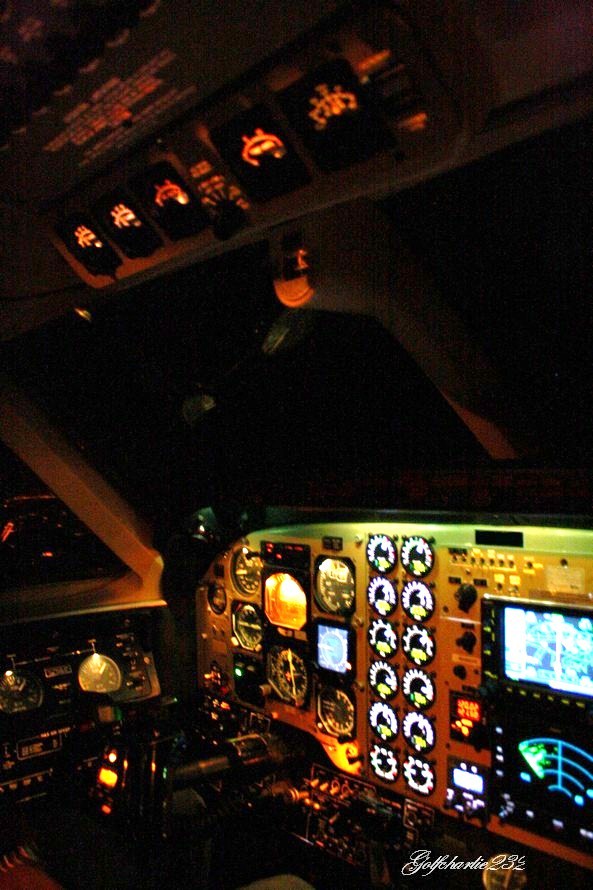
Airbus A320 - Twilight from the flight deck

The view from an office usually gets fairly boring and pretty much never changes. Well, unless you're an airline pilot.
Most people know what the usual office looks like, but they don't realise how good it can get up front in the flight deck of an airliner. We still call it an office since this is where we work, although it doesn't have a lot in commun.

Even when we fly the same routes everyday, the view does change a lot, depending upon the time of the day, and the time of the year.
In fact, the view alone is a great factor in making the flight deck of an airliner an amazing place to be in.

Pilots are often said to be dreamers, or people enjoying a bit of magic. When you get to see such views, you certainly understand why.

The twilight over the French Alps does catch your attention.
The sun is cracking the horizon and you suddenly get that truely superb golden light, spilling an intense orange light over the cockpit.
The Alps shape starts to form over my right shoulder, and Lake Geneva gets in sight.
Almost all the South-East part of France is covered with a thin layer of fog, adding to the beauty of the scene.
This is one of those moments you'd like to last forever, but at 600 miles an hour Paris is coming up very fast.

Airborne life continues...


Wednesday, 9 February 2011

Paris CDG - ATC visit

Thanks to a friend Air Traffic Controller, I got the opportunity to visit the CDG ATC once again (first time was with the International Air Cadets meeting in Paris (IACE)).
We spent a couple of hours in the night-used Central control tower.

During the day, there is one tower in use for each of the two doublet runways. The North one controls runway 09 Left and Right, for wich most aircraft go and depart from Terminal 1 and 3 (long haul foreign airlines flights).
The South one controls runway 08 L and R, for planes taxiing to and from Terminal 2 and S3, the Skyteam hub (mainly Air France).

There is a traffic tower, further East of the Terminal 2 and it is used for ground control only.
And then, there is a fourth control tower, right in the middle of the airport, used at night as a central tower while North and South towers are closed. That's the one we went in, allowing us to chat without disturbing anyone.

Fairly lucky today since the weather was actually good in Paris, apparently it does happen every now and then. I'm being sarcastic actually, the weekly forecast are more spring-like, perfect timing this is!

I managed to get a few decent shots, with quite a few twin-aisle airliners departures including a Singapore Airlines A380, a lot of 772 and 773, a few 747-400 and 747F, the US carriers 757 and 767, lots of ATRs and ERJs, and countless A320 series aircraft.
CDG being one of the busiest airports in the world, there is a lot going on all day long, to my greatest delight!

Airborne life continues...


Wednesday, 19 January 2011

Boeing 747-200 - European Skybus

Just a few pictures I took in the 747-200 Full Flight Simulator at European. We did not get the chance to fly it unlike others as it was in maintenance, but were offered a second free flight on the 737 instead.
Still very impressive inside!

I'm back in sunny France since then, and due to get back to flying the King Air within the next few days.
Looking forward to this.

Airborne life continues...


Monday, 17 January 2011

MCC Boeing 737-200, Phase 2

The most enjoyable part of the whole training finally arrived: flying the Boeing 737-200 Full Flight Simulator, in a multi-crew environment.

It would be a tough job to describe all the things we've covered within the 20 hrs flying our pocket rocket, but as a summary, here are the flight details:

Day 1: 2 hrs as Pilot Monitoring (PM), 2 hrs as Pilot Flying (PF),
Standard Operating Procedures (SOPs) familiarisation, checklists and cockpit layout (The 737-200 shares most of the overhead panel with the NG (New Generation) series (from the 737-600 to the -900)). Radar vectored departure out of London Stansted, standard climb-out procedures, normal manoeuvres, use of speedbrakes, operations of Flight Director and Auto-pilot, ILS/DME back in Stansted.

Day 2: 2 hrs as Pilot Monitoring (PM), 2 hrs as Pilot Flying (PF),
Departure and arrival briefings, crew communications, emergency radio communications and coordination.
Rejected take-off drills: below 80 kts, between 80 kts and V1, at V1, after V1, and go-around procedures.
Use of abnormal checklists.

Day 3: 2 hrs as Pilot Monitoring (PM), 2 hrs as Pilot Flying (PF),
Conduct a commercial flight with emergencies.
1st sector: Dean Cross 4C departure (SID) out of Edinburgh EDI, Talla VOR to 12 DME arc approach and ILS in Glasgow GLA.
2nd sector: New Galloway 2H departure from Glasgow, Lanak 1A to ILS/DME back in Edinburgh.
Use of de-ice and anti-ice, pressurisation failure (slow leak and explosive decompression), emergency descent with the oxygen masks, CAT I ILS/DME to minima.

Day 4: 2 hrs as Pilot Monitoring (PM), 2 hrs as Pilot Flying (PF),
Departure Dover 7R out of Stansted, airways route to Boulogne BNE, About 1D arrival, ILS/DME, go around and missed-approach procedure, visual/DME approach rwy 23.
Low visibility take-off (LVP), situation management, pilot incapacitation, microburst / windshear on final.

Day 5: 2 hrs as Pilot Monitoring (PM), 2 hrs as Pilot Flying (PF),
LOFT (Line Oriented Flight Training).
1st sector: Birmingham BHX to Prestwick PIK, Trent 1G departure, Turnberry 1D arrival, ILS to minima.
2nd sector: Prestwick PIK to Birmingham BHX, New Galloway 1K SID, Chase 2B STAR.
Although there was no emergency to deal with on this last 4 hour flight, the route is short and the workload gets fairly high. The SID have early turns (at 1nm DME), and we were required to hold at destination, and fly the procedure back in Birmingham due to no radar available at destination.

A very interesting week indeed.

Airborne life continues...


Sunday, 9 January 2011

MCC Boeing 737-200, Phase 1

After a month break, time needed to get our licences issued by the CAA, we're finally back in Bournemouth for one of the last steps of the training: the Multi-Crew Cooperation course.
It's broke down into two parts, starting off with the ground school, followed by 20 hours in a Boeing 737-200 Full Flight Simulator, 10 of which are flown as Pilot Flying (PF), and the remaining 10 hrs as Pilot Monitoring (PM).

It has nothing to do with Captain / First-Officer roles. The aim is, in part, to learn the tasks distribution among the two pilots. As "single-pilot Instrument Rated", we are taught to fly an aeroplane in which we perform all the tasks ourselves. Moving onto the airline, the flight crew is composed of two pilots, and we now have ground handling agents, cabin crew (flight attendants), company staff whom we can speak to over the radio while airborne, etc...
The roles (PF / PM) are usually swapped over every other sector, undependently of who's the Captain and who's the Co-pilot. And despite the designation of Pilot Monitoring (which used to be Pilot Not Flying), he is actually sometimes doing a tougher job than the pilot flying.

The simulator training is done in a Zero-Time Training Device, a six-axis full motion simulator, which allows to go straight on the plane and start the line training after a type rating. Unlike most type rating simulators, there's no need for touch-and-go training prior to flying with passengers.
Why is that useful during a MCC course? Well, it gives that extra bit of realism, and this is basically our very first experience at handling a swept wing jet, on a proper simulator.

As I haven't started the simulator training yet (other than learning the checklists, SOPs and cockpit layout), I can't comment on that part of the course.

However, the Phase 1 - Ground school has been focused on a lot of different aspects. Off the top of my head, those are the topics covered:

Oxygen rules,
Communications among the flight crew, flight attendants and handling agents,
Cabin crew emergency messages,
Leadership / Followership, envisioning, Situation awareness,
Altitude briefing,
Take-off Congifuration Warning (TOCW),
N1 / EPR gauges and icing errors,
Top of Descent (TOD) calculations and corrections,
Non-stabilised approaches and Go Around,
Approach limitations,
Checklists (Normal, Non-Normal and Expanded) and SOPs (Standard Operating Procedures),
PF / PM roles,
Handling a jet (flying on attitudes and thrust, Mach/IAS),
Airbus' and Boeing's philosophy on Automation, GPWS and EGPWS, TCAS, Flight director and Autopilot,
Refueling with passengers,
Slot time (reviewing plan, ordering fuel, notams WX, briefs F/A, exterior walk around, cockpit checks, departure briefing, load sheet, push/start,...),
Windshear / Microburst recovery,
B737-200 Flaps schedule (Take-off, Approach, and Go Around),
Conducting effective briefings,
Re-briefing an approach after a runway change,
Workload periods,
B737 Operating procedures (who does what on the flight deck), challenge/response, ...


Monday, 27 December 2010

Paris by night - King Air 90

Merry Christmas everyone!

The King Air 90 was standing proudly on the empty airpron tonight. The captain and I preflighted her in the cold winter wind while discussing the weather in Paris. The last few days have been quite snowy with icing conditions and they had to close a lot of major airports in Western Europe. Tonight however was forecast to be clear and cold but snow patches remained on some taxiways and on the runways' edges.

The two PT6 turbines came to life in the silent evening.
I took the controls shortly after take-off until we established in cruise.
We left Carcassonne (South of France) following the SID (Standard Instrument Departure) GAI2W, initially towards Charlie Sierra, the airfield beacon, then turning Northbound heading to the GAI VOR after 14 nm. Further on the way, the control cleared us direct TUDRA.
Although the past few days have been really snowy, today was superbly clear and smooth all around and the visibility was surely above 100 miles.
Toulouse, birthplace of Airbus and ATR, passed under our left wing.
The altitude warning broke the calm atmosphere of the night as we passed 21,000ft, alerting us we had 1000 more feet to go to the selected altitude.
Doing 265 kts TAS (True Airspeed), almost 50 kts of head wind at this level, we entered central France. Darkness suddenly became quite apparent.

At 22,000ft, the ride was glassy smooth.
In the middle of the night, talking helps us to stay awake. The captain, a former long haul airline pilot, has a lot to share. For me, as a young and unexperienced pilot, this is like a dream.
I have ambitions for my carrier, but nothing is easy in the Aviation World. Also, things usually don't go as planned, and this can actually happen to be a good thing sometimes.
You often wonder how you ended up here? What path and decisions did you take to make things like they are? I certainly wouldn't have believe a few months ago I'd be flying a King Air today...

As we approached Paris, shining reflections from the city lights started to appear on the flight deck, and the view outside became simply mesmerizing.
We loaded the approach for the ILS runway 07 via BALOD.
I gazed amazed at the beautiful city, the Eiffel Tower and the skyscrapers forming the business district of La Defense. Departing the group of buildings is one of the main and most famous streets in Paris, the Avenue Charles de Gaulle, leading to the Arc de Triumphe and coming out the other side as Les Champs Elysees. If you have a close look at the pictures below, you should be able to spot all the famous landmarks.

The ATC cleared us for the approach and I got back on the controls, capturing the Localizer above 10,000ft and the Glide Path at 9000 ft.
Still doing just under 200 kts IAS and established on final runway 07 at Le Bourget (Paris executive airport), we passed abeam Les Champs Elysees. I rushed to grab my camera and get a few shots.
I got the runway in sight ahead of us. The captain selected the decision Altitude on the radalt and took care of the thrust and props levers for me.
Altitude came down and the radalt computer announced out loud "500", and seconds later "minimums" as we reached DA (Decision Altitude).
The threshold passed beneath us and the Captain slowly retarded the throttles as I flared the King Air. The tires touched down gently. No need to apply the reverses as the runway wasn't completely clear of snow and we were asked to vacate at the far end, 3000m (10,000ft) further down the long strip of concrete. We crossed runway 09 to slip into the main ‘avenue’ of FBOs and aircraft operators at Le Bourget. Parked between a Learjet and another Kingair, we shut down the two engines, bringing us back to the silent evening, but even colder this time. This is Paris...

Airborne life continues…