Sunday, 21 November 2010

The IR Journey

The usual IR course day is composed of one flight and one backseat, with all the planning that comes along.
Unfortunately this week has been pretty busy at PAT and despite the great efforts to fit me in, I didn't get to fly a lot.
We visited three new airports (Exeter, Bristol International and Alderney), which are all exam routes.

A typical test profile starts off with a 45 minute planning (that's the time allowed to fill in the logsheet, the mass & balance and take-off/landing performances calculations, the flight plan, and a quick study of the route and the approaches procedures).
If some of this is not pre-filled in advance, it is close to impossible to do everything properly in less than an hour.

To make things a bit more interesting, we don't fly the inbound leg as a straight line towards the destination. Instead, we usually depart backtracking a beacon (BIA NDB at Bournemouth), to intercept a radial from another beacon (usually SAM VOR), leading to a waypoint (THRED, MULIT, EXMOR, ...) and/or an airway (N864 between Exeter and Cardiff, Q41 between Southampton and the Channel Islands towards ORTAC), before joining the arrival at destination.

Once there, we either do a procedural approach or a radar vectored (by ATC) approach. A procedural approach is drawn on an "approach plate" and is allocated to one particular type of approach. And there is actually plenty to choose from. They can be "precision approaches" : ILS/DME or ILS only (using Markers), or "non-precision approaches": Loc/DME, VOR/DME, VOR timed, NDB/DME, NDB timed, Rnav (GPS), etc ...
The VOR and NDB approaches usually imply a final track offset to the runway axis, we come down to an angle with the runway, and once we become visual we make a small adjustment in turn before landing. (cf picture below)

Before commencing the approach, we usually go into the "hold", a pattern aiming at delaying the landing time. Not that we need to delay the arrival every time we fly, but as this is one of the not-so-easy parts of the flight, we get to fly at least one hold every flight. The tricky bit being to achieve the inbound track by the beacon, after a correction for the wind in the outbound leg. It probably doesn't speak to anyone who hasn't seen one.

I got the chance to do some rather fast descent to save some time (and money) in a more commercial way. Hence some indicated airspeed of 170 kts, and .. we had up to 220 kts ground speed at some point.
We then fly the approach in itself, and when coming down to DA (decision altitude) or MDA (minimum descent altitude), usually somewhere between 200ft and 400ft above the ground, we abort the approach and go around as if we didn't become visual at that point (which, in reality, would trigger a go around as well). That's where we get a simulated engine failure (the instructor pulls randomly one engine back to idle during the climb out).

After dealing with the engine failure and upon completion of the emergency drills, we then have to follow the "missed approach instructions", which we would have requested before commencing the approach. Heading back home (i.e. Bournemouth airport), we either get radar vectored (if we flew a procedural approach at destination) or fly the procedure if we were radar vectored at destination. Particularity here, the whole approach is now flown on one engine.

If we flew a precision approach (i.e. an ILS) at destination, we fly a non-precision approach back in Bournemouth (usually an NDB approach) or the other way around. The "screens" are kept until DA/MDA, point at which the instructor removes them while we continue the approach a bit further, before going around again, on one engine this time. Continuing visually (VMC), we fly a "circle to land" below a simulated (or real ...) cloud base of 700~800ft, still on one engine.

Other than for that last circuit, the whole flight is flown on instruments (IMC), and unless the weather is absolutely awful, the outside view is hidden by "screens" at all times.
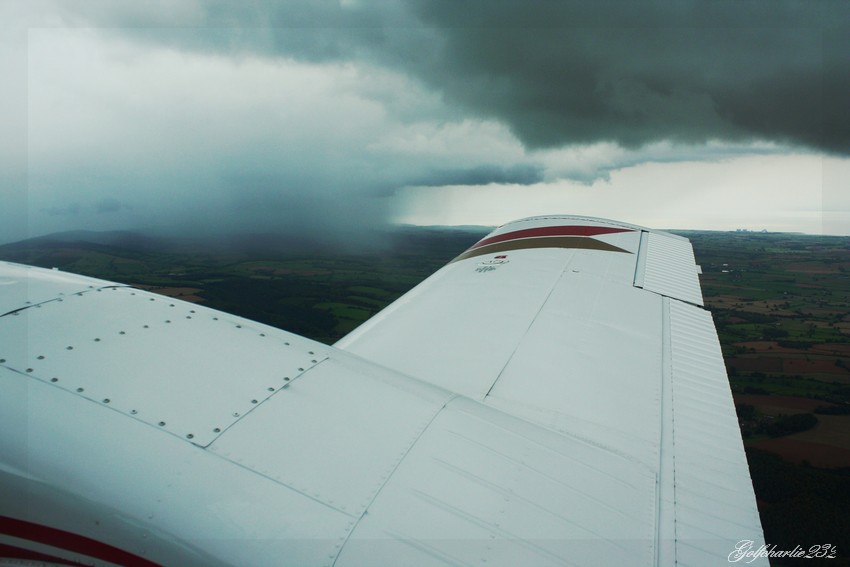
However, the view from the back seat is usually very enjoyable, made up from orange sunrays in the early mornings or late afternoons, exiting clouds surfing, or even exotic landscapes...

Airbone life continues...


Wednesday, 10 November 2010

Flights to Cardiff and Bristol Filton

Bournemouth - Bristol Filton - Bournemouth - Cardiff - Bournemouth, that was the plan for the day.
I flew the first two sectors, and Steve was doing the last two.
First IFR nav ever, that was quite a moment.
Flight plan filled, aircraft preflighted, there we were, walking on the airpron to board our plane with a strange feeling, that feeling you get when you prepare yourself for something new and you don't really know what to expect.
A moment later, cleared for take-off, I applied full power and soon the tires were sliding onto the runway at 75 kts indicated airspeed, our VR.
Positive rate of climb, gear up, 100kt, props back to 2500rpm / 25" manifold pressure, after take-off checklist.
On the climb-out, we picked up a bit of ice but as we punched through the cloud layer, the sunshine got rid of it without any trouble. Blue sky up there, as usual.
Flying roughly 150 kts true airspeed at Flight Level 80, we got handed-over to Yeovilton Radar, Cardiff Radar, Bristol Radar and finally Filton Approach.

I joined for a hold above the airfield followed by a procedure NDB (Locator) on runway 27. Despite it being my very first approach away from Bournemouth, it oddly went fairly well. As I was going around at my MDA (Minimum Decision Altitude, NDB approach), I got a glimpse of the now-stored Concorde, parked just South of the runway.
Incredible piece of engineering it was. Oh well. I had better going back to my flight because a moment later my instructor was throwing an engine failure at me. That's where it suddenly got very busy, Filton Tower asked me to contact the Approach and assigned me a southerly heading, while I was dealing with the simulated engine failure and doing all the drills.
A few minutes later, the City of Bristol was flowing under our left wing, I could get a clear view of the University of Bristol's Memorial Tower, where I studied Aerospace Engineering. Brought back some good memories.

The cruise flight back to Bournemouth was pretty much eventless, and the radar vectored ILS that followed was definitely a lot easier than the previous ones we made with a 40 kts wind.
Back on mother Earth, quick swap of the crew , and we were soon back in the air at sunset, to Cardiff this time. Most of the flight shared the same route, flying into the N864 Airway northbound and leaving at EXMOR, a waypoint a dozen miles South of Cardiff, for a runway 12 ILS approach.
The Welsh capital suddenly emerged as we were descending towards Cardiff International in the cold night. Some shiny orangish reflections got the windshield all illuminated. It does feel quite intense in those moments.
We came back in some smooth evening air to Bournemouth to complete the flight with a procedure NDB followed by a circle to land (visual circuit with a simulated cloud ceiling of 800ft).

Airborne life continues...


Wednesday, 3 November 2010

Be76 Cloud Surfing IFR

Sim check done and dusted, we're finally back in the plane for the last 20 hours of training.
The first few flights are familiarisation with the IFR procedures, holds, vectored ILS, general handling, stalls under IMC (Instruments Conditions), some more partial panel (flying instruments with no Artificial Horizon, no HSI and no RMI), etc ...
Then come the navigations, and finally the test profiles.

I took a few pictures while backseating Steve's flight and made a short video for your enjoyment.

Airbone life continues...


Wednesday, 27 October 2010

Instrument Rating, 4 weeks locked in a sim

The IR (Instrument Rating) is probably the most important course towards the airline flying. This is where we're taught all the procedures flown on instruments (and not visually unlike the CPL), flying in all kinds of awful weather.
My flightmate and I started the course the day following my CPL Skill Test. Not much of a break indeed.
We jumped straight onto the FNPT1 simulator (Procedures Trainer) for the first 10h of the course.
The course in itself is designed to teach someone who's never done any Instruments Flying before, from the very biginning. However, as part of the CPL course we did 10 hours instruments, so some of the basis was already acquired. We skipped that and started off with some general NDB/VOR tracking and procedure turns (cf flight sheet below), and the 2nd flight was about holds and ILS Approaches.
Within 10 hours, we managed to cover Bournemouth 26 and 08 hold procedures, ILS and NDB Approaches, Bristol Lulsgate, Bristol Filton, Exeter (both runways, NDB/DME, NDB timed (NDB out) and ILS procedures) and an IFR route (Bournemouth -> Alderney).
It all went really fast, and our very experienced flight instructor (ex airline pilot and crew selection examiner) knows exactly how to increase the level on each flight so that we never get any relaxing time in any part of the flight. We were soon thrown at all kinds of systems failures, emergencies, flight plan amendements, etc ...

Then came the much nicer FNPT2 simulator, still a procedure trainer but type specific this time, looking a bit more alike the Beechcraft 76 Duchess with a decent visual.
That part of the course lasts 20 hours and ends with a sim check which we'll take on monday next week. We basically simulated the flights we'll do on the real aeroplane, from start-up to finish. We mostly used it to get to understand how to fly procedures, how to use the equipement, the ATC, get in the habit of decision making, reading plates, etc ... In that regard, it is really good at teaching us procedure related stuff. But to be honest the flying in itself is not that realistic. It's not a motion sim, the flight enveloppe differs quite a bit from the real aircraft, so do attitudes and power settings, engine failures are pretty unrealistic, but the aim is simply to teach students the drills and the procedures before they move onto the plane where the workload will get much higher.
We did some more procedures, navigations, airway joins, DME arcs, etc ...
PAT (Professional Air Training) is currently the only school in the UK to teach Rnav (GNSS) approaches and we tried that at Exeter.
After 20~25 hours, there's not much more to learn from such a simulator if you're confident with what you've done so far, there's no point really in doing the same procedures all over again and learning them by heart. Most students actually struggle through this part of the IR since everything is new, but to be honest both Steve and I were well ahead of the game, we really enjoyed it and kept up with the tough level our instructor was looking for. He basically took us a step beyond that of the CAA, altitude holding went from the IR minima of +/- 100ft to his minima of +/- 20ft ... Most navaid trackings were down to the degree and decision making became soon entirely ours.

The joy that results from doing a good flight, trying to stay ahead of the plane most of the time, and breaking through clouds at minima to land in some deep fog on a runway far from home, is just incredible. Most people won't get it, but when aviation has been your thing since you were in nappies, reaching that point (quite quickly frankly) is basically achieving a dream.
Having completed the course within 25hr instead of the standard 30, we had a chance to do some LOFT (Line Oriented Flight Training), AP coupled approaches, SIDs (Standard Instrument Departure) and STARs (Standard Terminal Arrival Route).

IR flights chronicles due to start next week, with hopefully some nice pictures and videos from up there.

Airbone life continues...

Some of the pictures include the visit of an ex PAT student pilot who's now flying the Citation Mustang, and a backseat on Sarah's flight to Cardiff.


Wednesday, 6 October 2010

The World's Most Beautiful Office

People often ask me what's so special about flying? Why would someone want to be an airline pilot?

There are so many different aspects that it is just impossible to cover them all.
Let me just try to put some words on what it feels like to break through a cloud layer when the sun is setting.

Seating on the runway and waiting for our take-off clearance, the good old Lycoming O-360 engines are rolling over at idle thrust waiting for my hand to push the two thrust levers forward.
The whole city is stuck under a dark grey menacing-looking cloud layer.
Being cleared for take-off, I bring the mighty Duchess to life, all vibrating under the combined 360 horsepower which, all of a sudden, tear the silent evening.
Moments later, I raise the nose by about 5°, announce "Positive rate of climb, Gear up" while lifting the gear lever and pitching up to our climb attitude of 8°. The ground flows under our wings. It's all dark out there, looks like it's going to rain any time soon. Our plane is set in the cruise climb, all systems are in the green, passing 1000ft I bank her gently left on a South-Easterly heading to intercept BIA's 161° bearing.
As climb continues, I loose sight of the horizon and the plane starts bouncing a bit more as we enter clouds. 161 is coming, drift applied and I'm now tracking outbound towards THRED, a waypoint off the shore.

And just before I enter the airway, we punch through the cloud layer into a scene of incredible beauty. The sun is cracking the horizon above a sea of clouds...
An intense golden light is illuminating our faces, my smile is now clearly spreading ... It is one of those moments.

Southampton's VOR 206 radial is coming up as I reach 30nm DME, and turning right I'm now flying down the airway towards ORTAC.

Cruise check done, established at Flight Level 60, I've now got 33 miles to run before reaching ORTAC to enjoy this truely magical moment. This is where our mind focuses for a few seconds on the souls below, probably enjoying some rain right now.
That leaves me speechless.

Does it get any better?
Probably not...

I left behind the VFR charts as the visual flying part is over, it's all about accurately tracking towards and from beacons now, we've got a handful lot of work to do in the simulators but the joy of learning how to actually fly an airliner is truely exciting.
In just a few hours, Steve and I have been learning a lot about NDB holds with and without wind, ILS/DME approaches, IFR navigation, etc ...
We're in the hands of the excellent Steve Y. , our flight instructor, who's constantly monitoring every little movement we make. He possesses excellent airmanship skills and really knows how to pass them onto his fellow students. I can only be greatful to be seating there today.

I remember a few years ago, classmates, flightmates, relatives and other know-it-all kind of people looking down at me and telling me very seriously "don't be ridiculous, pilots are people with incredible mathematical ability, they're the best of the best, this is just not for you".
Looking back at those memories, all I can think of now is compassion for those people, most of which are stuck in traffic jams every morning on their way to some boring work, each day looking similar. Still a long way to go on my side, but I do believe I'll eventually make it to the airline, and whatever happens in between, I won't regret a thing. I gave my life a huge turn, moved abroad, and acted to make things happen. I didn't ask anyone any help nor any money, and like many people did before me, I turned my back to those who like to spread gloom and doom, left them behind, and walked ahead to some promising future.

I'm looking forwards to more and more flights, more and more skills to take onboard, and more magic from the incredible sight above the clouds.

Airborne life continues...


Sunday, 3 October 2010

Commercial Pilot

6:00am. The sky is going from a foggy orange dark to blue dark as the morning sets up, the town is slowly waking up.
Today is different from the other days, I finished my CPL training a few days ago, passed the so-called 170A exam, and it's now time to confirm that I can properly do all what I've been trained for in a professional and commercial manner, and cope with any kind of emergency.

A few hours later, after some time standing at the airport and looking at the weather forecast, I finally meet Captain Dave R. at the CAA test centre.
We both agreed we would brief and prepare the flight as we would normally do if the weather was great, and we will check it again just before going flying.
Today, our flight will take us to Colyton, a small village a dozen miles East of Exeter, in Devon.
We meet again 45 minutes later, discuss the performances calculations under today's conditions, and as we will probably land in Dunkeswell as a diversion, I also check the landing and take-off performances, as well as the mass & balance sheets. We complete the briefing with a few questions regarding Air Law and the Be76 specifications.
The forecast reveals a flyable window of around 2 hours and some decent weather to the West.
We jump in the plane, start up the engines and get the ATIS. We've got some FEW clouds at 3000ft, more than 10k visibility, which for once isn't bad at all. Taxi, line-up and take-off, and I'm soon in the cruise on my first leg towards Colyton.
Bad luck comes soon, and this is exactly what happens in real life, the cloud ceiling gets down to around 1500ft AMSL, it's overcast, there are rains showers and some nasty weather ahead. I take the decision to divert and fly on a North-Easterly heading that will get us in some much better weather. Unfortunately, the forecast are never very accurate and that's what we've got to deal with. I manage to complete all the remaining sections of the CPL Skill Test and pass them all.
Despite the navigation being cancelled, it is still a lot to do and fatigue comes to play eventually. Instrument flying, VOR and NDB tracking, partial panel, timed-turns, unusual attitudes while in IMC without the artificial horizon, stalls in approach and landing configurations, simulated cockpit fire, engine fire and actual shut-down followed by an emergency descent, all kind of circuits, engine failure after take-off, N-1 landing, aborted take-off, etc ...
I finally land the plane about half an hour before the rain arrives in Bournemouth.

Then comes the debriefing, and I'm left in some mixed feelings. That's an incomplete CPL Test but I actually passed everything we could do. A bit frustrating I must say.
The next day turns out to be absolutely awful, and I eventually cancel the test.
Finally, thursday looks slightly better. Same as two days ago, we should have a two hour window to fly VMC, and I decide to give it a go.
I've got a different examiner, a different navigation to plan of course (see below), and a cloud ceiling averaging to around 1800ft. They forecast some nasty weather coming soon so we must go before that.
We're soon flying in some smooth air at 1500ft, below the clouds on our way to Evercreech. A few miles later, the cloud ceiling is down to 1400 ft (with some high ground up to 800ft), there are rain showers on my path and it just gets really tricky. It is still flyable but it just can't get any worse. I have to avoid every localised rain shower, and maintain a 500 foot separation between me and the ground. All this while entering a Military Air Traffic Zone and trying to get back on the exact track initially planned. Evercreech is not hard to find, and I head onto my diversion the examiner just gave me. Alderhot, just North of Bournemouth airport. The weather is getting even worse unfortunately, and although the cloud base enables me to fly reasonnably high, the visibility is now down to just a few kilometers. Track correction at the half-way point as the wind seems to have increased in the meantime, and I finally end up on track and on time over Alderhot. Flight test is complete, the examiner takes control and this is it, I'm no longer a Private Pilot, I just became a Commercial Pilot (or Professional Pilot as we call it in France).

Friday, 17 September 2010

First "real" ILS on the Be76, CPL Test Profile and 737-200 sim session

We had a lot going on this last few days. That was a pretty busy week indeed, starting with two days of absolutely crap weather (windy, low clouds forming an overcast layer just above the 500 foot mark, and to make it even better, some rain showers pretty much everywhere in this part of the country).
Perfect weather to do the instrument flying bit of the CPL course. Although we were flying instruments in actual instrument meteorological conditions (IMC), we did use the screens as we popped out of the clouds eventually, enjoying (well, when backseating) some nice sunshine whilst people below us were enjoying some rain ...
On the way back of those two flights, we got the chance to do a Radar Vectored ILS, and break out from clouds around 700ft, with the runway magically appearing in sight right in front of us. The feeling resulting from this is really intense, it really is a huge joy after some really tough work keeping the plane on the glide path and centred on the localizer to pop out of the clouds and happen to be correctly aligned and at the correct height.

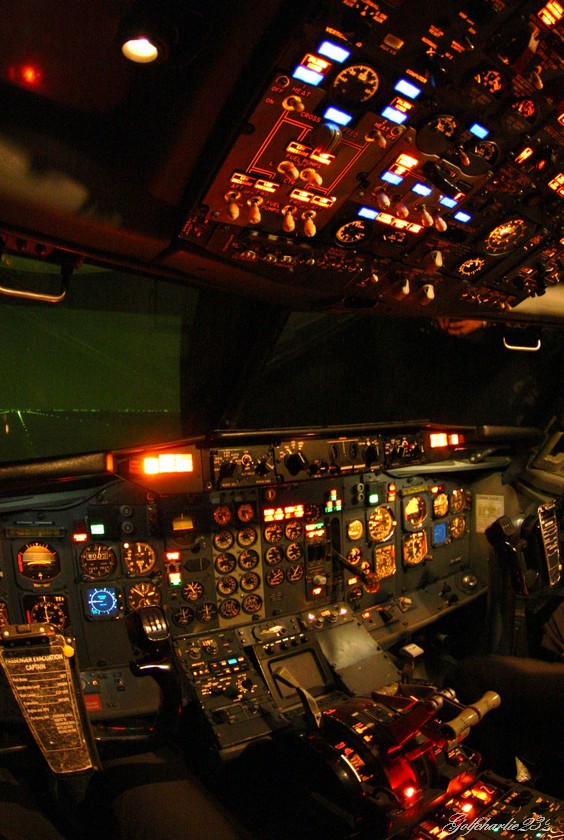
As Steve and I booked our MCC (Multi-Crew Co-Operation) course at European Skybus on the 737-200 Full Flight Simulator (full motion), we got the chance to get our hands on her for a circuit from London Stansted. We now can't wait to get started with that last part of the training (which should take place sometime between December and January).

Wednesday was the first Test Profile, a two hour flight to Blackbushe (just North of Farnborough, on the edge of London). The way out was made up from two planned legs (visual navigation) with a Matz penetration (Boscombe), joining the circuit pattern at Blackbushe, doing some flapless approach, engine failure after take-off, one engine go-around (N-1), then departing through the overhead to then fly through Farnoborough's ATZ on a diversion leg (unplanned navigation) towards the Coast, doing some radionav position fixes on the way. Then came the general handling part, where we had to show some stalls recovery, steep turns, engine fire drill and emergency descent. And finally, on the way back home, some instrument flying (with the screens), partial panel, unusual attitudes recovery, and VOR tracking (HSI/RMI). Just before joining the circuit pattern at Bournemouth, we had to deal with an engine failure (simulated) and land on one engine.

Thursday, a much more relaxing flight (in a way) practicing general handling, instrument flying and NDB tracking.
And on friday, another Test Profile, to Dunkeswell this time.
If we get along with the weather, both Steve and I should have our 170 test on monday and the CPL skill test should follow within the next few days. Fingers crossed.


Steve flying the approach on the 73